
Sherlock Scenario
Sherlock Overview
We receive a log indicating a possible attack, can you gather information from the .pcap file?
Log file: Desktop/ChallengeFile/webserver.em0.pcap
The only evidence was webserver.em0.pcap, a short capture of 65 packets between a client and a web server, which I opened in Wireshark.
HTTP Basic Authentication
Basic Authentication sends the username and password in an
Authorization: Basic <value>header, where the value is justusername:passwordencoded in Base64. Base64 is an encoding, not encryption, so anyone who can see the traffic can read the credentials. Over plain HTTP that means anyone on the network path.
Task 0: Number of GET requests
How many HTTP GET requests are in pcap?
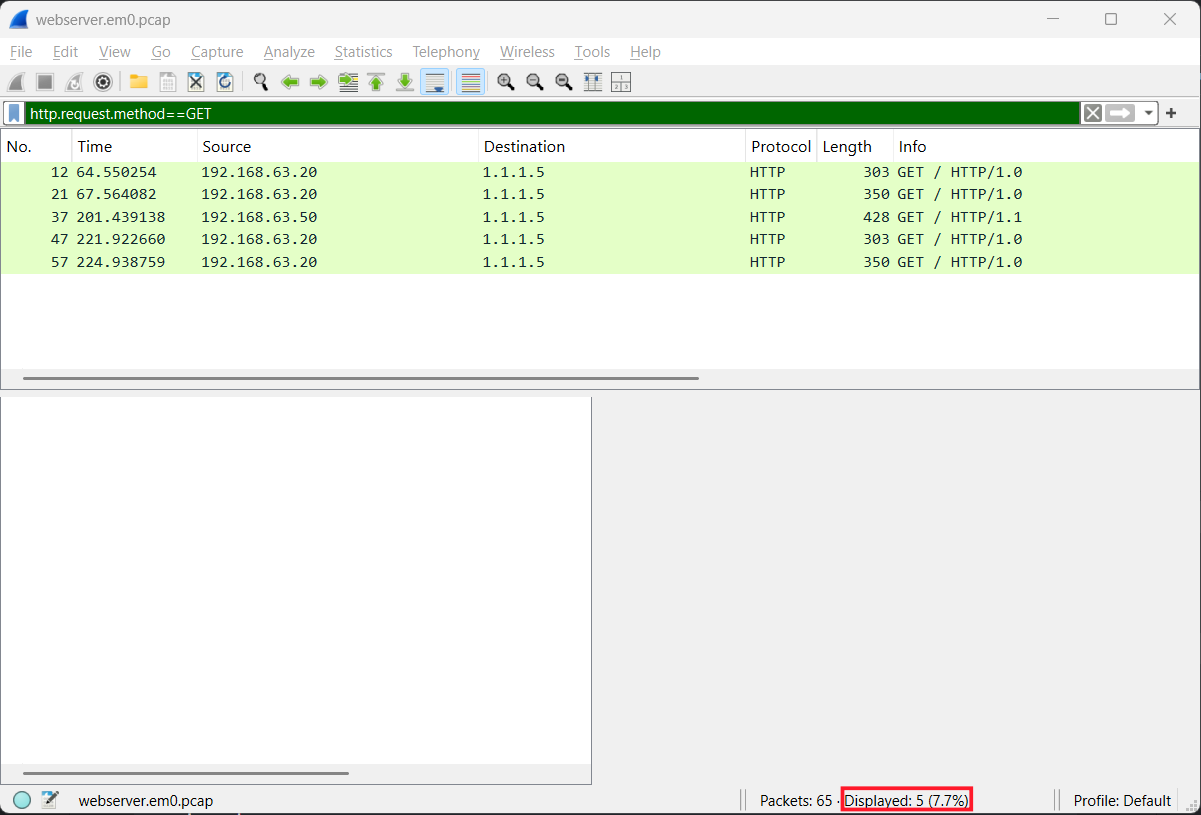
I filtered for GET requests:
http.request.method==GET
Answer
5
Task 1: The server’s operating system
What is the server operating system?
Servers often announce themselves in the Server response header. I right-clicked one of the requests and chose Follow > HTTP Stream to read the whole exchange:
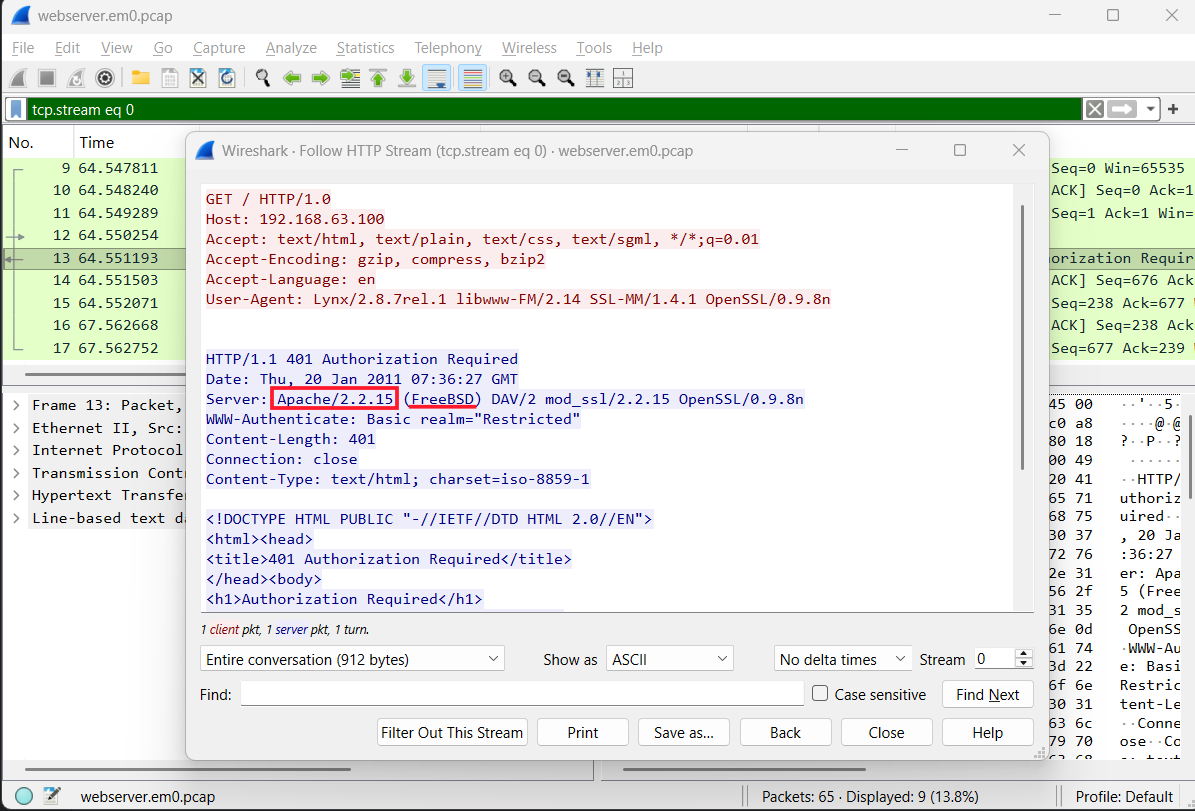
The server identifies itself as Apache/2.2.15 (FreeBSD) DAV/2 mod_ssl/2.2.15 OpenSSL/0.9.8n. The operating system is in brackets.
Answer
FreeBSD
Task 2: The web server software
What is the name and version of the web server software?
The first part of the same Server header:
Answer
Apache/2.2.15
Task 3: The OpenSSL version
What is the version of OpenSSL running on the server?
The last part of the same Server header. Version information this detailed is useful to an attacker, who can match it against known vulnerabilities. OpenSSL 0.9.8n dates from 2010.
Answer
OpenSSL/0.9.8n
Task 4: The client’s user agent
What is the client’s user-agent information?
The client’s requests (shown in red in the stream view) carry a User-Agent header:
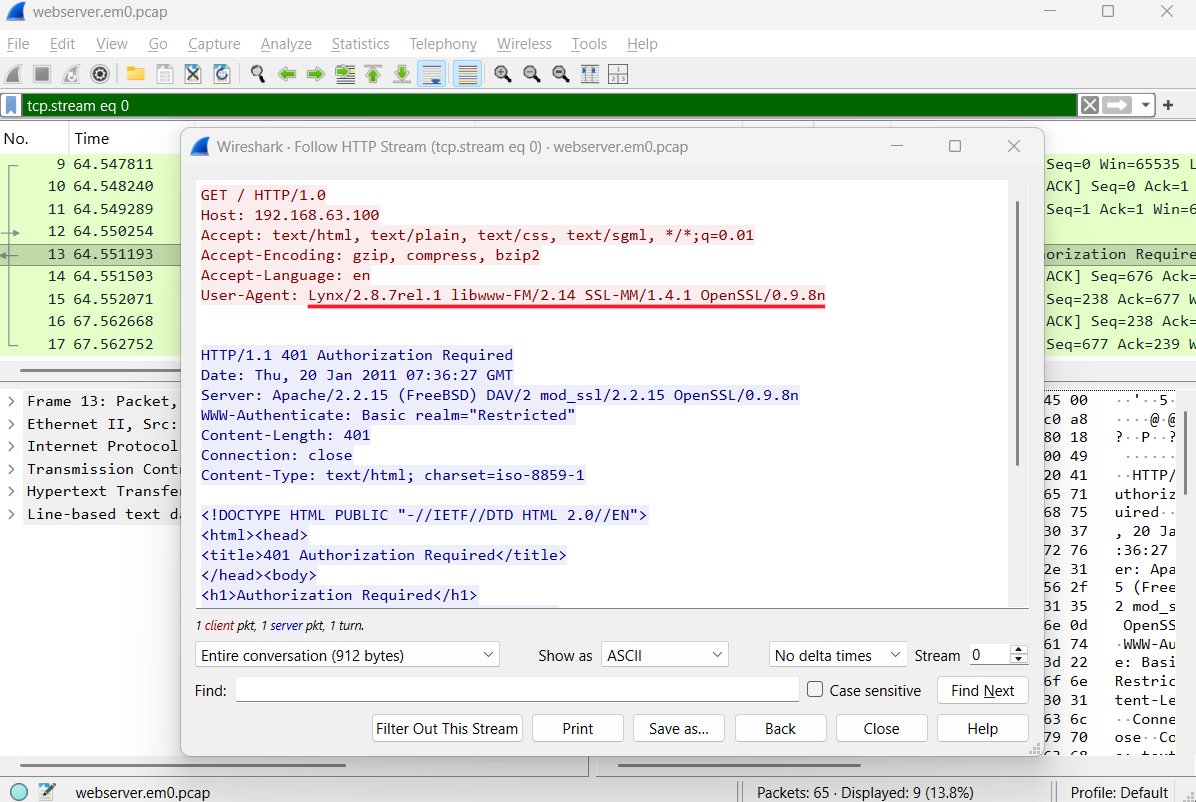
Lynx is a text-only browser that runs in a terminal. Four of the five requests used it, all from 192.168.63.20. The fifth came from a different client, 192.168.63.50, which identified itself as Internet Explorer 6 on Windows XP.
Answer
Lynx/2.8.7rel.1 libwww-FM/2.14 SSL-MM/1.4.1 OpenSSL/0.9.8n
Task 5: The username
What is the username used for Basic Authentication?
The capture shows the usual Basic Authentication exchange. A request without credentials gets 401 Unauthorized, and the browser retries with an Authorization header. The second request in the capture got a 200 OK and the Apache “It works!” page, so the credentials it sent were accepted.
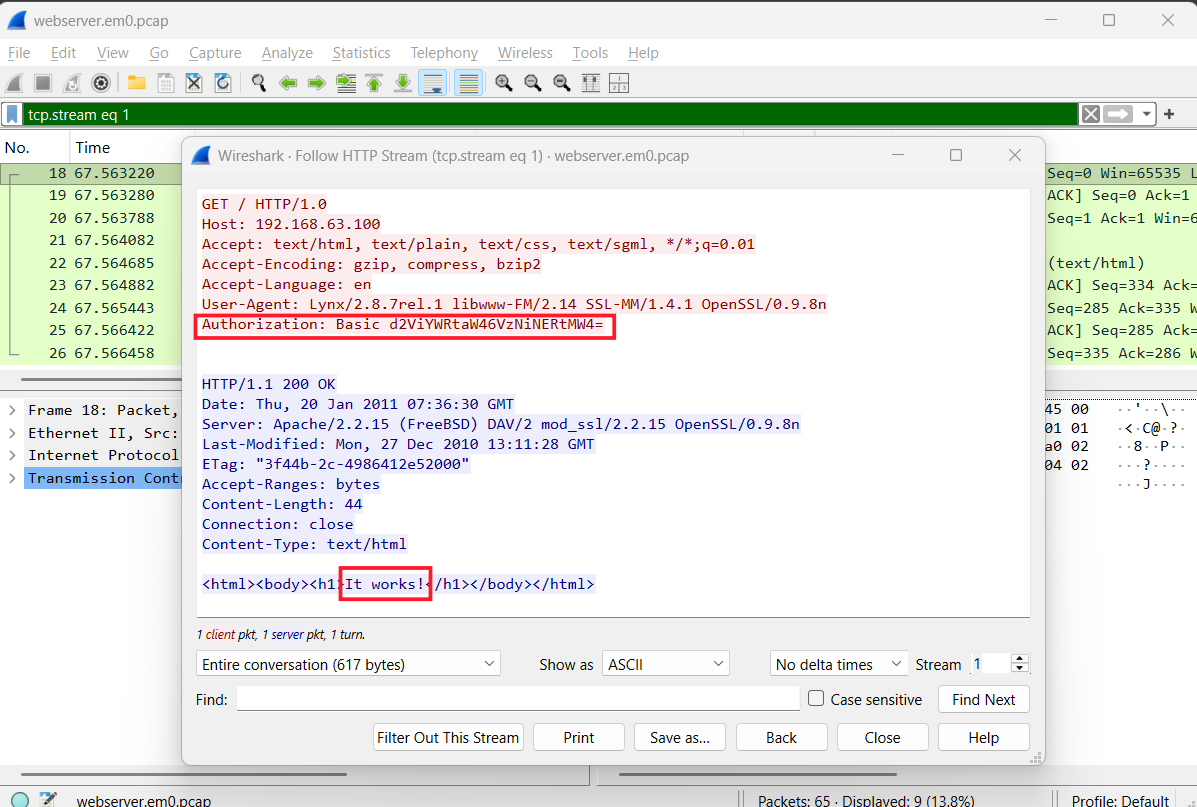
Its header read:
Authorization: Basic d2ViYWRtaW46VzNiNERtMW4=
Decoding the value:
ubuntu@DESKTOP-R1DTBOS:~$ echo "d2ViYWRtaW46VzNiNERtMW4=" | base64 -d
webadmin:W3b4Dm1n
The part before the colon is the username.
Answer
webadmin
Task 6: The password
What is the user password used for Basic Authentication?
The part after the colon in the decoded header:
Answer
W3b4Dm1n
Similar
- HTB Sherlocks - Port Scan Activity: another short packet capture investigation
- HTB Sherlocks - Noxious: credentials recovered from network traffic, this time an NTLM hash that had to be cracked